
Society for Francophone Postcolonial Studies Annual Conference 2026
Postcolonial Temporalities
20-21 November 2026
Institute for Languages, Cultures and Societies, Senate House London
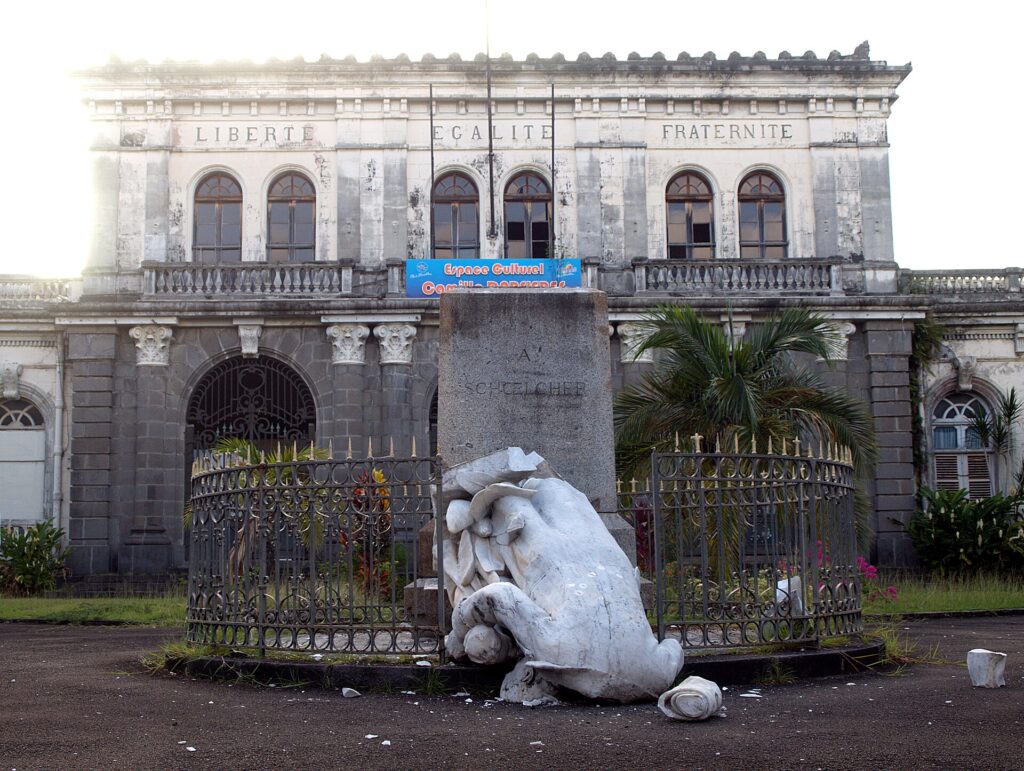 La statue de Victor Schoelcher renversée et partiellement détruite dans le square de l’ancien Palais de Justice de Fort-de-France, en Martinique. 22 May 2020. Photo Credit: Toto @ Matinino, CC BY 2.0 <https://creativecommons.org/licenses/by/2.0>, via Wikimedia Commons.
Conference registration is now open! Please complete and send the registration form to sfpsannualconference@gmail.com by Monday 2nd November.
Programme
ILCS, Senate House, Malet Street, London
SFPS Annual Conference 2026: Postcolonial Temporalities
Friday 20th & Saturday 21st November 2026
DAY 1 – Friday 20th November 2026
8.45: Registration, Coffee/Tea
9.15-10.15: Keynote 1 – The Kate Marsh Memorial Lecture: Fraser McQueen (University of Leeds), TITLE TBC. Chair: X. Chancellors Hall, Mezzanine Level.
10.30-12.00: Parallel Sessions (1)
|
Panel 1A: Absence, Nonhistory (Chair: X) Chancellors Hall, Mezzanine Level |
Panel 1B: Ecological time (Chair: X) Room G22, Ground Floor |
||
|
1 |
Sanyu Mulira (Georgia Institute of Technology), ‘Excavating the French Caribbean Radical Tradition in Martinican History’ |
1 |
Erin Twohig (Georgetown University), ‘Postcolonial Time and Nuclear Aftermath in Algerian Futuristic Writings’ |
|
2 |
Rehnuma Sazzad, ‘Aesthetics and Politics in the Decolonial Struggle of Édouard Glissant’s Caribbean Discourse (1989)’ |
2 |
Hadley Galbaith (Grinnell College, University of Iowa), ‘Waiting for Fate, Creating New Realities: Ecological change, slow colonial violence, and embodied relation in the silences surrounding disruption’ |
|
3 |
Nasrin Qader (Northwestern University), ‘Mohammed Dib and the Times of Play’ |
3 |
Sadie Berry-Firth (New York University), ‘Ecologies of Impossibility’ |
|
Panel 1C: Photographs, images, and the optics of temporality (Chair: X) Room G26, Ground Floor |
|
|
1 |
Amanda Rosso (Birkbeck, University of London), ‘Fractured Lineages: Photography and Postcolonial Time in Leïla Sebbar’ |
|
2 |
Isabelle Hidair-Krivsky (Université de Guyane), ‘Corps Hantés et Temporalités Racialisées : Survivances Coloniales, Recursivité des Images et Paradoxes Visuels dans les Campagnes Féministes en Guyane’ |
12.00-13.30: lunch (Chancellors Hall, Mezzanine Level)
12.30: SFPS AGM (room G22)
13.30-15.15: Parallel Sessions (2)
|
Panel 2A: Mapping temporalities (Chair: X) Chancellors Hall, Mezzanine Level |
Panel 2B: Migrant time (Chair: X) Room G22, Ground Floor |
||
|
1 |
Christ-Levy Leboba (l’Université de Perpignan), ‘Tango noir face au spectre colonial : Blanchissement de la culture africaine au sein de la République argentine au XXIe siècle’ |
1 |
Joanne Brueton (University of London Institute in Paris), ‘Allô ? The call of the past in Nassera Tamer’s palimpsestic poetics’
|
|
2 |
Caroline D. Laurent (The American University of Paris), ‘Unseen Paris: Absent Images, Present Histories’ |
2 |
Raji Vallury (University of New Mexico), ‘Migrant-Cosmopolitan and Cynic: The Disjunctive Temporalities of Migrancy and Travel in Salim Bachi’s Amours et aventures de Sindbad le marin’ |
|
3 |
Mohamed Amine Khoudi (Mouloud Mammeri University), ‘Catastrophic Transnational Temporalities in Yasmina Khadra’s The Sirens of Baghdad: Dislocating Beirut and Baghdad’ |
3 |
Alexandra Reza (University of Bristol), ‘The working day and immigrant struggles in 1970s France’ |
|
4 |
Maya Boutaghou (University of Virginia), ‘1830 Algiers: Autopsy of a year in space’ |
4 |
Sonia Lamrani (University of Boumerdes), ‘A Concept in Transit: ‘The Native Informant’ from Colonial Archives to Contemporary Media Platforms’ |
|
Panel 2C: Time and Memory (Chair: X) Room G26, Ground Floor |
|
|
1 |
Mahashweta Lahiry (The English and Foreign Languages University), ‘L’analyse de la narration du malaise vis à vis du pays natal: Une exploration mémorielle’ |
|
2 |
Hemza Boudersa (Constantine 3 University), ‘Finding Resonance of Memory and History in Algerian Literature in French. A Particular Emphasis on Assia Djebar, Kateb Yacine, and Kaouther Adimi’ |
|
3 |
Sayant Vijay (Amrita University), ‘Colonial Afterlives Beyond Decolonization: Memory, Citizenship, and the French Enclaves of Mahé and Pondicherry’ |
15.15-15.45: Coffee break
15.45- 17.15: Parallel Sessions (3)
|
Panel 3A: Indigenous approaches (Chair: X) Chancellors Hall, Mezzanine Level |
Panel 3B: Relational time (Chair: X)
Room G22, Ground Floor |
||
|
1 |
Bill Marhsall (University of Stirling), ‘Memory, Trauma, Apocalypse: Indigenous Filmmaking in Quebec’ |
1 |
Adjimaël Halidi (Université Laval), ‘La frontière invisible : colonialité des sciences sociales et conflit des temporalités dans la recherche française sur Mayotte’
|
|
2 |
Flavia Espindola (University College Cork), ‘Can the Jaguar Speak? Challenging (Neo) Colonial Silences in The Jaguar’s Roar by Micheliny Verunschk’ |
2 |
Dicle Çetin-McDonald (Hacettepe University), ‘Specters of Brontë : The Hauntological Imagination From Yorkshire to the Caribbean’ |
|
Panel 3C: Temporal transformations (Chair: Fraser McQueen) Room G26, Ground Floor |
|
|
1 |
Laëtitia Saint-Loubert (Nantes Université), ‘Translating Contemporary Francophone Literature Against the Clock’ |
|
2 |
Cloé Artaut (Sciences Po and University of Cambridge), ‘‘Ma France, c’est Joséphine’. The Panthéonisation of Joséphine Baker (2021) and the Recursion of Republican Temporality’ |
|
3 |
Annabelle Koberg (Universität Potsdam), ‘Against Competitive Memory: Multidirectional Temporalities in Mohamed Mbougar Sarr’s La plus secrète mémoire des hommes (2021)’ |
17.30-18.30: Maryse Condé and Caribbean Crossings: Reading Condé’s Literary Legacy. With Kate Hodgson (University College Cork), Felisa Vergara Reynolds (University of Illinois Urbana-Champaign), Keithley Woolward (Columbia Global Paris Centre), and Clare Finburgh Delijani (Goldsmiths).
Chair: X. Chancellors Hall, Mezzanine Level.
18.30-19.30: Vin d’honneur, generously sponsored by Liverpool University Press. Chancellors Hall, Mezzanine Level.
20.00: Conference Dinner: Tas Restaurant, 22 Bloomsbury Street WC1B 3QJ (pre-booked with registration)
–
DAY 2 – Saturday 21st November 2026
9.00-10.45 Parallel Sessions (4)
|
Panel 4A: Literary temporalities (Chair: X) Chancellors Hall, Mezzanine Level |
Panel 4B: Temporal twists (Chair: X) Room G22, Ground Floor |
||
|
1 |
Tommaso Testolin (Università degli Studi di Padova / EHESS-CRH), ‘« Nos bagages pour la traversée » Chloé Delaume face à l’histoire’ |
1 |
Valérie K. Orlando (University of Maryland), ‘Crime, Memory, and the Fait Divers: Investigating French Algerian History in Kebir Ammi’s Le Coiffeur aux mains rouges (2025)’ |
|
2 |
Abubakar M. Wakil (Bayero University), ‘La critique politique dans les œuvres africaines postcoloniales : une analyse de Les fers de l’absence d’Helene Kaziende et Petit piment d’Alain Mabanckou’ |
2 |
Papa Bocar Ndaw (Université Cheikh Anta Diop), ‘De la poétique de l’instant chez Aimé Césaire à la temporalité relationnelle d’Édouard Glissant : Écrire le temps postcolonial dans l’espace antillais’ |
|
3 |
Alyssa Ollivier-Tabukashvili (University of Oxford), ‘The Enduring Oratrice: Cross-temporal, embodied narration in Algerian women’s writing’ |
3 |
Weibing Ni (University of Cambridge), ‘Imbricated Temporalities between Indenturedship and Slavery: Marronage in Raphaël Confiant and David Dabydeen’ |
|
4 |
Daniel Lightfoot (University of St Andrews), ‘Social Integration and the Temporalities of Precarious Labor in Three Contemporary French Novels’ |
|
|
|
Panel 4C: Futurities (Chair: Jennifer Boum Make) Room G26, Ground Floor |
|
|
1 |
Catherine Blanchard (Université Sorbonne Nouvelle Paris 3 / Paris Cité / Université des Antilles UFR Arts & Médias), ‘Entre archives et futurs : afrotropes, caribatropes et contre-temporalités visuelles afro-diasporiques’ |
|
2 |
Zihan Zhou (Universidad Complutense de Madrid), ‘Fear and the Politics of a Promised Future: Affective Temporality in L’Année du Lièvre’ |
|
3 |
Roswitha Zahlner (Saint Louis University), ‘Dreams of Flight in Fatima Mernissi’s Dreams of Trespass and Hong Kingston’s The Woman Warrior’ |
|
4 |
Charlotte Joublot Ferré (l’Université Paris 8–Vincennes-Saint Denis), ‘Dystopies connectées, voix décoloniales : récit bref et futurs spéculatifs’ |
10.45-11.15: Coffee Break
11.15-13.00: Parallel Sessions (5)
|
Panel 5A: Queer Time I (Chair: Todd Reeser) Chancellors Hall, Mezzanine Level. |
Panel 5B: Rebels, Heroes, and Myths: Rewriting Narratives of Slave Revolts (Chair: X) Room G22, Ground Floor |
||
|
1 |
Peter Tarjanyi (Middlebury College), ‘Ashes and Sand: Anti-chrononormativity in the Cinema of Nouri Bouzid’ |
1 |
Adlai Murdoch (Penn State), ‘Narrativity, Temporality, and l’épopée Delgrès 1802 in Daniel Maximin’s L’isolé soleil’ |
|
2 |
Chantal Zabus (Université Sorbonne Paris Nord), ‘Afro-queer-and-trans Futurities in Francophone Postcolonial West African Literature’ |
2 |
Clare Finburgh Delijani (Goldsmiths), ‘Ghosts, Heroes and the Haitian Revolution’
|
|
3 |
Don Joseph (University of Missouri), ‘Deferred Returns: Queer Temporality and Postcolonial Recursion in Tu reviendras’ |
3 |
Jane Hiddleston (University of Oxford), ‘‘Le nègre qui relève plus de l’arbre que de l’homme’: Makandal as Environmental Hero?’ |
|
Panel 5C: Against ‘Resilience’: Haitian Temporalities in Literature and Film (Chair: X) Room G26, Ground Floor |
|
|
1 |
Alessandra Benedicty-Kokken (University of Amsterdam, University Docent), ‘Against ‘tragedy’: Haitian poetry as critique’ |
|
2 |
Michaelle Vilmont (Duke University), ‘The Body as Archival Passagère in the Fragmentation of Atlantic History’ |
|
3 |
Rose Flaure Accilien (University of Miami), ‘Coloniality, Linguistic & Resistance | Rewriting the Archipelago through Creole’ |
|
4 |
Cécile Accilien (University of Maryland), ‘Reconfiguration of Time and Space in the work of Contemporary Haitian Filmmakers: Gessica Généus, Edson Jean and Al’Ikens Plancher’ |
13.00-14.00: Lunch
14.00-15.30: Parallel Sessions (6)
|
Panel 6A: Queer Time II (Chair: Chantal Zabus) Chancellors Hall, Mezzanine Level |
Panel 6B: Archiving temporalities (Chair: X) Room G22, Ground Floor |
||
|
1 |
Todd W. Reeser (University of Pittsburgh), ‘Transgender Modernity in Tahiti’ |
1 |
Daniel Nabil Maroun (University of Illinois), ‘The Unarchived Dead: HIV/AIDS and Colonial Aphasia’ |
|
2 |
Marshall L. Smith (Swarthmore College), ‘Francophone Fault Lines: Negotiating Black Queer Subjectivities between Caribbean Integration and Senegalese Criminalization’ |
2 |
Erika Martin (Sciences Po), ‘Mémoires et conséquences de la Guerre d’Algérie : Continuités coloniales aux musées’ |
|
3 |
Wissame Rais (Université Sorbonne Paris Nord), ‘Temporalités postcoloniales du genre : vivre la transidentité en Algérie entre invisibilisation, attente et réinvention de soi’ |
3 |
Johanna Montlouis-Gabriel (Emory University), ‘Re-staging the Colonial Image: Postcard Temporalities and Digital Counter-Archives in Adeline Rapon’s Work’ |
|
|
|
4 |
Chaima Benhsaina (Columbia University), ‘Tracking the subterranean poetics of Ahmed Bouanani’s L’Hopital (1980) and Les Persiennes (1980)’ |
15.30-16.00: Coffee Break
16.00-17.00: Postcolonial Nomadism and Decolonial Translations: Bilingual readings from poet Alecia McKenzie. Chancellors Hall, Mezzanine Level.
17.15-18.15: Keynote 2 – The Dorothy Blair Memorial Lecture: Jennifer Boum Make (Georgetown University). “The French Outre-mer’s perspectives on Well/Ill-being: Investigating Decoloniality and Temporalities of Healing.” Chair: X. Chancellors Hall, Mezzanine Level.
18:30: Conference Close
–
Call for proposals
How do postcolonial francophone literatures, cinemas, other visual cultures and cultural practices reconfigure time and, if so, why? Postcolonial theory has long insisted that colonialism operated not only through spatial domination but through the imposition of temporal hierarchies. Francophone thinkers have provided crucial conceptual tools for this inquiry. Édouard Glissant’s Poétique de la Relation (1990) imagines an archipelagic, relational time that is one of continuous interaction and transformation that is resistant to linear progress narratives. Jacques Derrida’s reflections on spectrality in Spectres de Marx (1993) foreground the persistence of unfinished pasts within the present. And, following this, we might think of Anne Laure Stoler’s work (2016) in which she argues against seeing colonial history as either a clean break or a straight continuity but instead a form of recursion in which colonial patterns resurface, re-inscribe, and reconfigure themselves over time, producing uneven, layered, and emergent temporal effects that shape governance today. Maryse Condé’s novel, Moi, Tituba sorcière… (1986), amongst others, stages recursive histories of slavery and rebellion through multi-temporal narrative structures.
Indeed, francophone postcolonial cultural production offers many pathways to explore temporal folds. Seth Graebner in History’s Place. Nostalgia and the City in French Algerian Literature (2007) places historical consciousness and nostalgia at the centre of Algerian writing, demonstrating how colonial urban space — with features such as the clock tower in Bône/Annaba — becomes a site where colonial and postcolonial temporalities collide in Kateb Yacine’s Nedjma (1956). Such collisions also form part of Assia Djebar’s temporal poetics with L’Amour, la fantasia (1985) interweaving colonial archives, women’s voices, and fragmented narration to produce a layered, non-linear historiography of Algeria.
Thus, from disrupted revolutionary chronologies and suspended post-conflict presents to speculative and environmental futures marked by climate crisis, francophone texts from Africa, the Caribbean, the Maghreb, the Machrek, the Indian Ocean, and Francophone North America persistently challenge homogeneous, developmentalist time. Environmental degradation, extractive economies, and planetary precarity introduce new scales – deep time, ecological time, the time of catastrophe – into postcolonial cultural production. Whether through the haunted city, the eroded coastline, or the desertified landscape, we invite scholars to analyse, and discuss, francophone postcolonial works that stage temporal struggle as both aesthetic strategy and political claim. How do they invite renewed reflection on how francophone postcolonial studies can think historical rupture, ecological vulnerability, and the unfinished work of decolonization, both in the past and to come?
This conference seeks to interrogate postcolonial temporalities, from a broad, critical, intersectional and interdisciplinary perspective. Papers devoted explicitly to the conference’s theme are welcome, as are contributions that interrogate any aspect of francophone postcolonial studies through the prism of time. Possible topics below; these are indicative rather than exhaustive.
- Speculative futurities, afrofuturism
- Colonial ghosts and haunted presents
- Planetary time
- Post post-colonialism
- Postcolonial time in media narratives
- Enduring (everlasting) colonial temporalities.
- Digital Future colonialism
- Afterlives of racial violence
- Emergent and erased racialities
- Parallel temporalities
- The Assertion of ‘Now’
- The Future of Anticolonial ‘Pasts’
- Cultural restitution: past, present, future
- Ecological change and relationships over time
- “Slow violence” in postcolonial contexts
- Memories, histories, and lieux/noeuds de mémoire?
The conference will take place in person, November 20th – 21st 2026 in the Institute for Languages, Cultures and Societies, Senate House, London. We invite abstracts (350 words) for 20-minute papers, in English or French, to:
sfpsannualconference@gmail.com, on or before May 4 2026. Proposals for full panels are welcome.
Society for Francophone Postcolonial Studies
PG and ECR Study Day 2026
Common Ground: Locating Solidarities in the Francophone Postcolonial World
Conference registration form: click here
Friday 12th June 2026, CACSSS Seminar Room, University College Cork, and online.
9:00: Coffee, registration
9:15: Welcome address by Laura Kennedy, Patrick Crowley, and Oliver Davis
9:30-10:30: Keynote address by Dr Nicki Frith (University of Edinburgh). Chaired by Patrick Crowley ‘From Recognition to Reparation: The Politics of Solidarity in the French Republic and Beyond’
10:30-11:45: Panel 1: Articulating Solidarity. Chaired by Oliver Davis
– Émilie Hautemont (Tulane University): ‘In Search of an Anticolonial Sisterhood: Gisèle Halimi and Hélène Cixous’s Visions of Identity and Solidarity’
– Amanda Tavares* (Universidade Nova de Lisboa): ‘Reactivating transnational solidarities through audience engagement in recent installations by Zineb Sedira’
– Hanane Bessami* (M’Hamed Bougara of Boumerdes University): ‘The Representation of Solidarity in Post/Colonial Algeria in Djamal Amrani’s Sous un tas de décombres’
11:45-13:00: Panel 2: Reframing Solidarity. Chaired by Laura Kennedy
– Rachael Barrett (University of Michigan): ‘The Fédération Française des Eclaireuses and the Limits of Gendered Solidarity, 1931-1954’
– Alison Clare (University of Birmingham): ‘Inviting Rita Felski to the Rasanblaj: Postcritque as a Postcolonial Methodology’
– Lucy Taylor (University of Liverpool): Entwined Memory, Entwined Complicity: Understanding the Complexities of Senegalese Complicity in French Concentrationary Violence (1939-1944) through Debarati Sanyal’s Decolonial Lens of “Memory-in- Complicity”
13:00-14:00: Free time for lunch
114:00-15:15: Panel 3: Solidarities in Postcolonial France. Chaired by Aedín Ní Loingsigh
– Daniel Lightfood (University of St Andrews): ‘French universalism and working-class identity reimagined in Joseph Ponthus’ À La ligne’
– Nick Bartlett (Columbia University): ‘Sembene in Marseille: Radicalism and Labour Solidarities’
– Shirley Le Penne*(Cornell University): ‘Unmaking Political Prisoners in La Santé’
15:15-15:45 Flash presentations. Chaired by Kate Hodgson
Niamh Furlong (University College Cork)
Ellen Cawley (University College Cork)
Aideen Teresa Mitchell (University College Cork)
Delilah Pearson* (University of Oxford)
15:45-16:00: Coffee break
16:00-17:15: Panel 4: Fanonian Approaches. Chaired by Sinan Richards
– Chris Dodd (University of Oxford): ‘‘Réinterroger le sol’: Madness and Common Ungrounding in Fanon and Derrida’
– Sonia Kherif*(M’Hamed Bougara of Boumerdes University): ‘From Frantz Fanon’s Damnés to Lynda Chouiten’s Hair: Satirizing Postcolonial Algerian Alienation’
– Chloé Luu* (University of Southern California): ‘Hashish and Fanonian Filiations: Vietnamese-Algerian Revolutionary Intimacies Reimagined in Nguyen’s The Committed’
17:15-18:30: Vin d’Honneur , opportunity to network
18:30: End of Conference
*online presentation
