
Postcolonial Temporalities
20-21 November 2026
Institute for Languages, Cultures and Societies, Senate House London
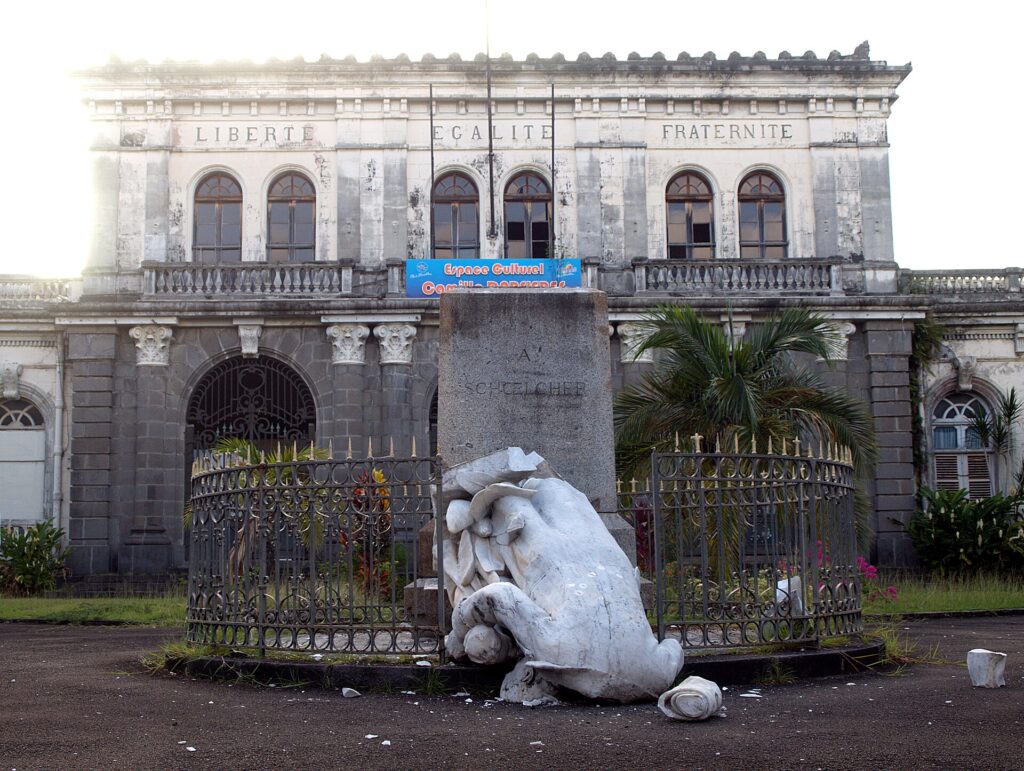 La statue de Victor Schoelcher renversée et partiellement détruite dans le square de l’ancien Palais de Justice de Fort-de-France, en Martinique. 22 May 2020. Photo Credit: Toto @ Matinino, CC BY 2.0 <https://creativecommons.org/licenses/by/2.0>, via Wikimedia Commons.
How do postcolonial francophone literatures, cinemas, other visual cultures and cultural practices reconfigure time and, if so, why? Postcolonial theory has long insisted that colonialism operated not only through spatial domination but through the imposition of temporal hierarchies. Francophone thinkers have provided crucial conceptual tools for this inquiry. Édouard Glissant’s Poétique de la Relation (1990) imagines an archipelagic, relational time that is one of continuous interaction and transformation that is resistant to linear progress narratives. Jacques Derrida’s reflections on spectrality in Spectres de Marx (1993) foreground the persistence of unfinished pasts within the present. And, following this, we might think of Anne Laure Stoler’s work (2016) in which she argues against seeing colonial history as either a clean break or a straight continuity but instead a form of recursion in which colonial patterns resurface, re-inscribe, and reconfigure themselves over time, producing uneven, layered, and emergent temporal effects that shape governance today. Maryse Condé’s novel, Moi, Tituba sorcière… (1986), amongst others, stages recursive histories of slavery and rebellion through multi-temporal narrative structures.
Indeed, francophone postcolonial cultural production offers many pathways to explore temporal folds. Seth Graebner in History’s Place. Nostalgia and the City in French Algerian Literature (2007) places historical consciousness and nostalgia at the centre of Algerian writing, demonstrating how colonial urban space — with features such as the clock tower in Bône/Annaba — becomes a site where colonial and postcolonial temporalities collide in Kateb Yacine’s Nedjma (1956). Such collisions also form part of Assia Djebar’s temporal poetics with L’Amour, la fantasia (1985) interweaving colonial archives, women’s voices, and fragmented narration to produce a layered, non-linear historiography of Algeria.
Thus, from disrupted revolutionary chronologies and suspended post-conflict presents to speculative and environmental futures marked by climate crisis, francophone texts from Africa, the Caribbean, the Maghreb, the Machrek, the Indian Ocean, and Francophone North America persistently challenge homogeneous, developmentalist time. Environmental degradation, extractive economies, and planetary precarity introduce new scales – deep time, ecological time, the time of catastrophe – into postcolonial cultural production. Whether through the haunted city, the eroded coastline, or the desertified landscape, we invite scholars to analyse, and discuss, francophone postcolonial works that stage temporal struggle as both aesthetic strategy and political claim. How do they invite renewed reflection on how francophone postcolonial studies can think historical rupture, ecological vulnerability, and the unfinished work of decolonization, both in the past and to come?
This conference seeks to interrogate postcolonial temporalities, from a broad, critical, intersectional and interdisciplinary perspective. Papers devoted explicitly to the conference’s theme are welcome, as are contributions that interrogate any aspect of francophone postcolonial studies through the prism of time. Possible topics below; these are indicative rather than exhaustive.
- Speculative futurities, afrofuturism
- Colonial ghosts and haunted presents
- Planetary time
- Post post-colonialism
- Postcolonial time in media narratives
- Enduring (everlasting) colonial temporalities.
- Digital Future colonialism
- Afterlives of racial violence
- Emergent and erased racialities
- Parallel temporalities
- The Assertion of ‘Now’
- The Future of Anticolonial ‘Pasts’
- Cultural restitution: past, present, future
- Ecological change and relationships over time
- “Slow violence” in postcolonial contexts
- Memories, histories, and lieux/noeuds de mémoire?
The conference will take place in person, November 20th – 21st 2026 in the Institute for Languages, Cultures and Societies, Senate House, London. We invite abstracts (350 words) for 20-minute papers, in English or French, to:
sfpsannualconference@gmail.com, on or before May 4 2026. Proposals for full panels are welcome.